
This puzzle is a disguised Masyu puzzle, with the pink and red circles representing the white and black circles of that logic puzzle type.
Taken directly from the Nikoli page, the rules are as follows:
- Make a single loop with lines passing through the centers of cells, horizontally or vertically. The loop never crosses itself, branches off, or goes through the same cell twice.
- Lines must pass through all cells with black and white circles.
- Lines passing through white circles must pass straight through its cell, and make a right-angled turn in at least one of the cells next to the white circle.
- Lines passing through black circles must make a right-angled turn in its cell, then it must go straight through the next cell (till the middle of the second cell) on both sides.
To start solving this puzzle, you will want to begin at the outside edges. Since the line must go straight through each white circle and then turn on at least one side, and also extend two squares in two perpendicular directions from each black circle, the first moves are forced:
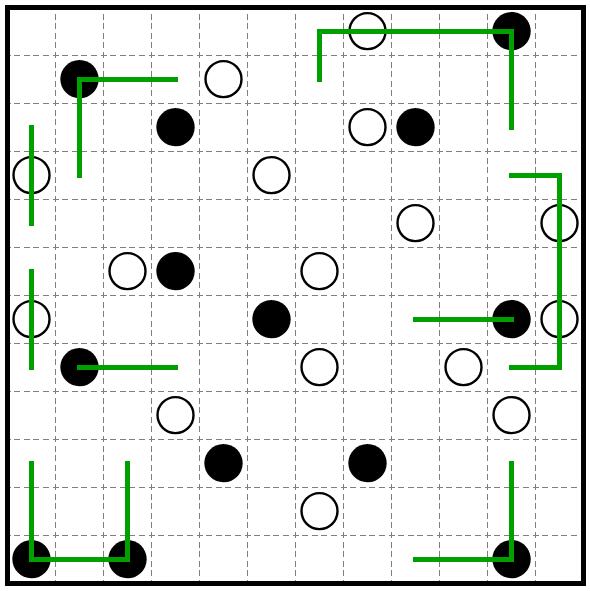
At this point, the lines we already have guide our next steps The black circle in row 3, column 4 (R3C4) cannot extend two squares up or left thanks to the existing line, so it must go down and right. Similar logic can be applied to the black circles in R3C9 and R7C11, albeit only in one direction each:
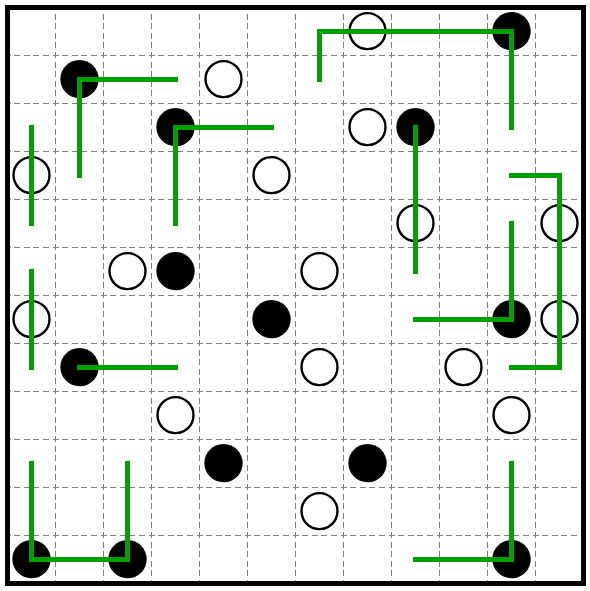
The white circle in R2C5 must have a horizontal line through it by these new lines, and the white circle in R4C1 must continue up into the corner and eventually loop around to meet that same line. This means the line must turn right in R5C1 (and also R6C1). Now, if R4C2 and R5C2 connect, a small loop will be created. Since the entire loop must be one piece, the line in R4C2 must go into R4C3 and R5C3, and R5C2 must connect to R6C2:

The black circle at R8C2 no longer has room to extend upward, and must go down, which forces the line in R8C1 to continue all the way down the left side. The line at R10C2 must turn right to avoid being cut off. All of this forces the line to travel vertically through the white circle at R6C3 before turning right in R7C3, and then the black circle at R6C4 must extend right and up:
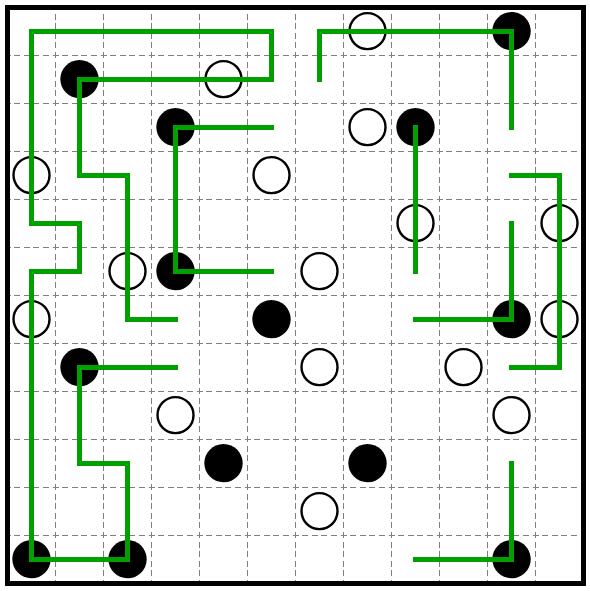
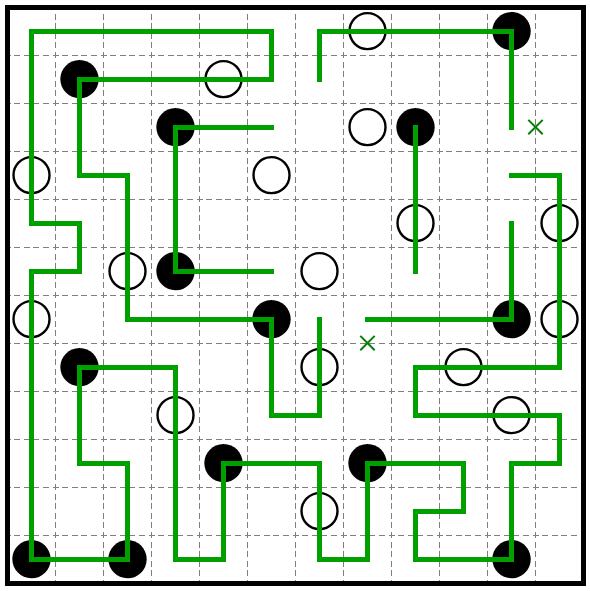
From this point, there follow a series of similar logical deductions to get to the following position, shown here with a few X’s where connections cannot be made:

If the black circle at R7C6 were to extend to the right, it would cut off any path for the white circle at R8C7, so it must go left. This forces the black circle at R10C5 to extend down and then left to avoid any ends being isolated:

This is the point where the logic gets somewhat more complex. If the lines ending at R7C9 and R8C9 connect, this forces the end at R5C11 to either connect to R6C9 or R2C7. In either case, the black circle at R3C9 is forced to extend left, cutting off the entire top-right section of the grid. Therefore, R7C9 must go left, and R8C9 must go down:

This leaves four line ends in the lower right (R9C9, R9C10, R10C7, R12C9). Since each line end must eventually be paired with another end, the line at R7C8 cannot turn down. The bottom right corner can now uniquely be solved:
Connecting R7C7 to R7C8 results in the same connectivity issues as connecting R7C9 and R8C9 earlier, so both lines must turn up, as must the line in R6C6. To avoid a small loop, the line must travel horizontally through the white circle in R4C6. Completing the connections from there gives this:

At this point, if the line extends right from the black circle at R3C9, it creates small, disconnected loops on both sides. Thus, it must go left, forcing the line at R2C7 to turn right. The final, forced steps lead to the following completed grid:
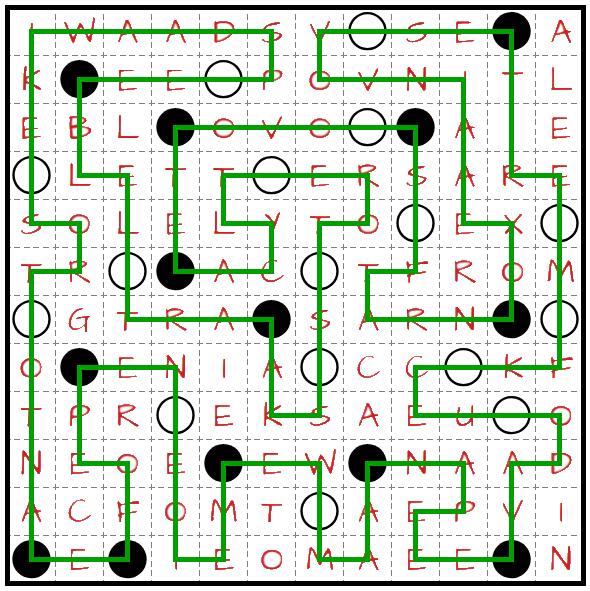
In the completed grid, the letters in the boxes which the line does not pass through, when read top-to-bottom, left-to-right, spell out the answer ALLERGIC REACTION.